Repertoire Data Exchange (RDx)


The Repertoire Data Exchange (RDx) is a collaboration within the music industry between producers and neighbouring rights organisations led by IFPI - International Federation of the Phonographic Industry (www.ifpi.org/) and Win - Worldwide Independent Music Industry Network (winformusic.org/). Development started with eight organisations (four producers and four neighbouring rights organisations) that are also responsible for testing, but the system is scalable for global use.
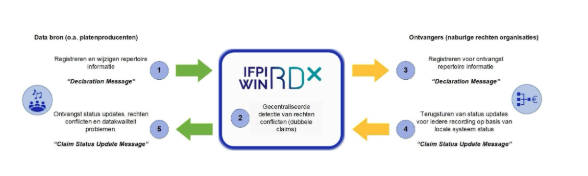 RDx enables record companies and neighbouring rights organisations to exchange standardised and uniform recording and rights information via a single central platform, a first step towards a “global data distribution chain for neighbouring rights”. RDx not only provides identical data that is easily and quickly accessible to all neighbouring rights organisations, but will hopefully also improve data quality across the entire sector.
Exchanging data
The Repertoire Data Exchange (RDx) is not accessible via a user interface. RDx operates on the principle that all participants supply and use data in a standard format. To exchange data, RDx uses the DDEX: Digital Data Exchange standards (ddex.net/). Participants must be able to send and receive DDEX RDR 1.4 messages. More information about DDEX RDR is available via this link.
Information is exchanged via sFTP, but the system is also accessible via an advanced API for searching for repertoire, status, conflicts and statistics, among other things. After registering rights, a producer receives feedback on data quality (missing and incorrectly filled fields), confirmation of registration with the participating rights organisations, any missing (mandatory) fields for registering rights per organisation and any rights conflicts in the countries of the participating rights organisations. Neighbouring rights organisations receive all new and amended rights information (periodically) automatically or by means of a query to the system.
 Exchange takes place on the basis of files for specific purposes:
• ‘Declaration message’ – used by rights holders (producers) to register repertoire and rights.
• ‘Claim Status Update Message’ – used by neighbouring rights organisations to inform rights holders (producers) about errors in files and/or rights conflicts. RDx also returns these to the rights holders (producers) immediately after importing them into RDx.
• ‘Request Message’ – used by neighbouring rights organisations to request details of specific recordings. (Requests will usually be submitted per ISRC, after which new data regarding the ISRC sent by producers to RDx via the ‘Declaration message’ will be automatically forwarded).
• 'Revoke message' – used by rights holders (producers) to revoke all registered rights to a recording if a (significant) error has been made when registering the rights.
Becoming an Rdx user
The Repertoire Data Exchange (RDx) is managed by an independent company, Repertoire Data Exchange Ltd. This company is a joint venture (50/50) between IFPI and WIN. In order to participate in RDx, all RDx users must comply with specific (contractual) conditions.
RDx is a data exchange between three types of users: rights holders (producers); data suppliers (those who send the repertoire data to RDx, producers or technical service providers who send the data on behalf of producers) and recipients (neighbouring rights organisations that need the repertoire and rights in order to pay the funds to the rights holders). RDx is a technical infrastructure and, as a result, users will have to comply with specific technical conditions in order to use the system. In addition, RDx provides for the transfer of rights to multiple parties, which means that users must comply with the conditions for data and rights registration in order to use the system.
Before RDx can be used, a new user (producer, data supplier or neighbouring rights organisation) must complete a so-called “pre-onboarding” process. During this process, the new user demonstrates via the test environment that they are ready to use the system; the data meets the criteria and the organisation can exchange data in the correct file format. In addition to registering, during which both contact details and “subscription preferences” are recorded by RDx Ltd, each user must sign a membership agreement in which they agree to the system's terms of use. This agreement includes provisions regarding:
• The notification of (relevant) changes to the registration details
• The registration and recording of repertoire and rights by RDx and recipients.
• The use of the various file formats, FTP exchange and use of the API by the various users of RDx.